
The AI virtual receptionist that answers instantly, 24/7
TL;DR
An AI virtual receptionist answers the phone in about 1 second and replies to your messages right away, 24/7 and on any channel: it says it's an AI, qualifies, books the appointment, and drops the lead into your CRM. It matters because whoever calls decides in the first few seconds whether someone picks up, or hangs up and dials the next name. And when the case calls for it, it moves the conversation to a person in one click, with full context.
Whoever calls your business decides in the first few seconds whether someone's picking up — or hangs up and dials the next name on the list. It isn't impatience; it's just how it works. That's why the metric that really moves your calendar isn't how good the voice sounds or how smart the AI is, but how long it takes to answer. An AI virtual receptionist that answers instantly picks up the phone in about one second and replies to your messages right away, any time of day and on any channel, and it's already working from the first moment: it says it's an AI, understands what you're asking, checks the calendar, and books the appointment. This article is a walk through the platform to show you exactly what happens in that first second, why speed is the product, and how the 24 hours get covered without a night shift.
What an AI virtual receptionist that answers instantly does in that first second
One second doesn't sound like much to brag about. But that second is the difference between a conversation that starts and a ringtone that keeps going until the customer hangs up. And more happens inside that second than it seems. It isn't just "picking up": it's picking up having already understood the context.
0.0 s — The contact comes in
A call rings, a WhatsApp arrives, or someone types in your website chat. The platform receives it the instant it happens.
~1 s — The AI responds
It answers the phone in ~1 second; messages it replies to right away. The first thing it does is say it's an AI — the transparency duty in AI Act art. 50.1 — and offer to escalate to a person.
Seconds later — It qualifies
It understands in natural language what the customer needs, filters out the noise, checks your real availability, and books the appointment on your synced calendar.
If needed — Handoff to a person
If the case calls for it or the customer prefers it, it moves the conversation to a human in one click, with the summary and full context already loaded.
Notice there are no menus, no "press 1 for appointments, 2 for information." That's the old way. The AI receptionist truly converses, in the customer's language, and that one second of response turns a fleeting intent into a booked appointment. That's why we say speed isn't a nice-to-have: it's the product. Everything else — sounding natural, knowing your business — only matters if it picked up first.
~1 s
how long it takes to answer, any time of day
One receptionist for voice, WhatsApp, and every channel
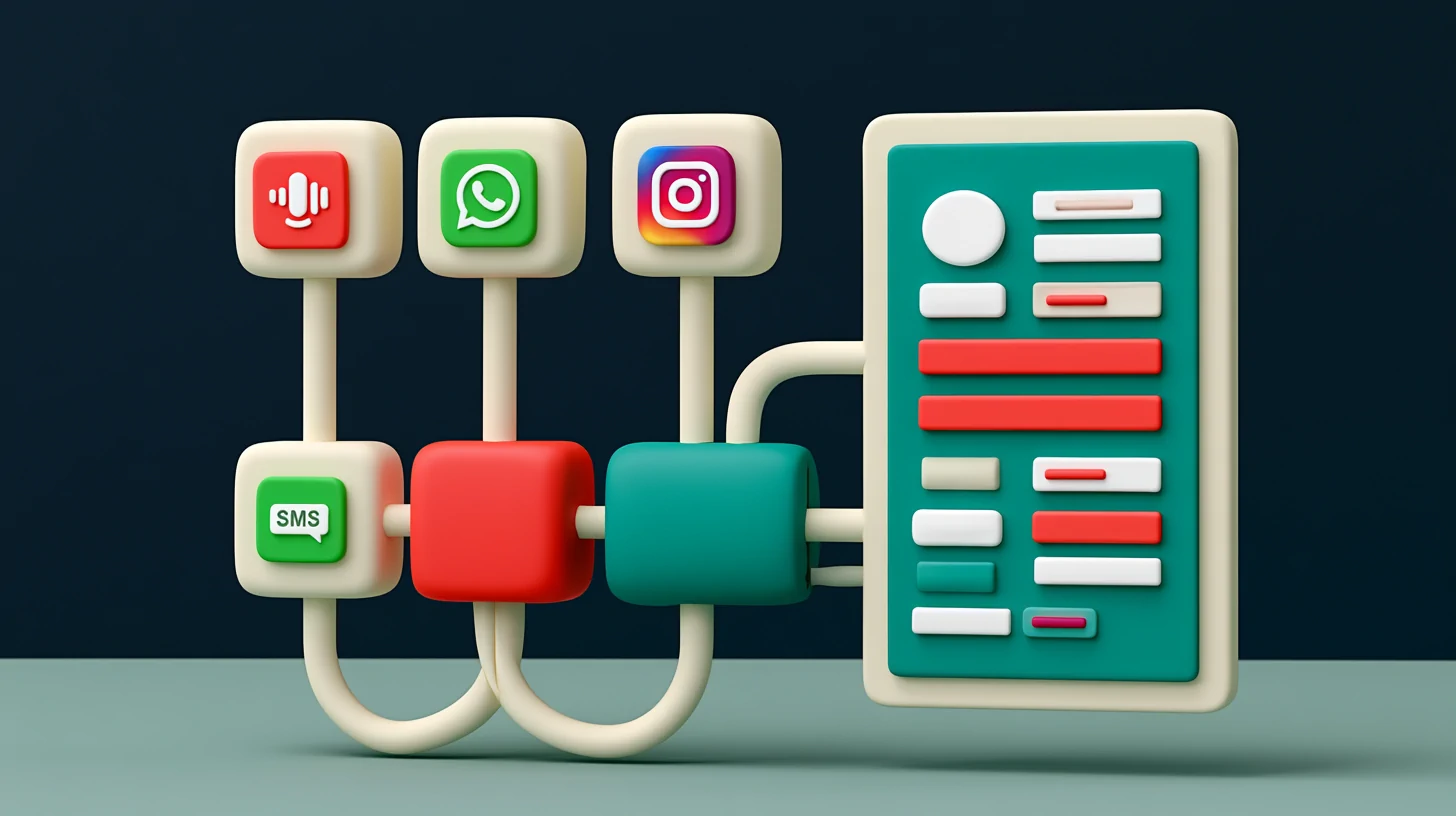
The phone is no longer the only door. A customer finds you on Instagram, texts you on WhatsApp, or opens your website chat at midnight. If a different person handles each channel — or nobody does — opportunities slip through the cracks. The beauty of an omnichannel AI receptionist is that it's a single one, and it handles all those doors at once with the same brain and the same speed: it answers instantly on a call just as it does on a message.
- Voice. It answers the phone and converses, with no IVR or menu levels.
- WhatsApp, Instagram, and Messenger. It replies to the message right away, not hours later.
- Text (SMS). The channel that was always slow, now with an instant reply.
- Web chat. The visitor who was hesitating on your site leaves with the appointment booked, not with a closed tab.
And the important part: everything lands on the same lead board. The customer picks whatever channel they like; you see it all in one place, with a summary of each conversation and the detected sentiment. There aren't four inboxes to watch: there's one receptionist that never sleeps and a board that organizes itself. If you want to see how leads slip away when you automate only one channel, we cover it in why automating WhatsApp alone lets voice and CRM leads slip away.
When WhatsApp gets checked "whenever there's a moment," the reply lands late. When it goes out right away, plenty of appointments are already confirmed before you open the door.
24/7 coverage: the 6 p.m.-to-9 a.m. gap that now gets covered too
Let's do the math on the hours. Say your business is open nine to six: nine hours with someone to pick up the phone. That leaves fifteen hours a day — plus whole weekends and holidays — when your number rings in a dark office. And it turns out that gap is exactly when a lot of people have time to call: after dinner, Saturday afternoon, Sunday. Intuition says the important calls come in during business hours; the reality is that your calendar fills up with the ones that come in when nobody's there.

Covering that gap with people means several paychecks, shift premiums, and still someone who can't take two calls at once. The AI covers those exact same hours for a flat fee, handles simultaneous calls, and leaves the work done for when your team opens. The next morning nobody arrives to a list of half-understood messages: they arrive to a calendar with confirmed appointments. We lay it all out in the guide on how to offer 24/7 phone coverage without hiring anyone.
Answering instantly and staying compliant: the part almost nobody mentions
Here's the detail many providers sweep under the rug: an AI receptionist that answers calls and stores customer data can't treat privacy as an afterthought. If you take calls from or handle data of EU residents, the GDPR (Regulation (EU) 2016/679) and the AI Act (Regulation (EU) 2024/1689) apply to you, and that's not optional. Even when they don't reach you, they're the world's strictest privacy bar, so building to them is a premium baseline worth having (in the US, expect AI-disclosure and call-recording norms from the FTC and state law to point the same way). The good news is that speed and compliance aren't at odds. It's built in from that first second — an AI disclosure (AI Act art. 50.1), data-protection information, and the option to escalate to a person — with nothing for you to wire up yourself.
The fear
If it's an AI, the customer will feel deceived.
How it actually works
The AI says it's an AI at the start of the conversation. That's the transparency duty in AI Act art. 50.1, and we already apply it as standard.
The fear
Once they're in the bot, the customer is stuck.
How it actually works
The customer can always ask for a person, and the conversation moves to a human on the same call. It isn't a legal requirement for a booking bot, but we offer it by default.
The fear
My data ends up who knows where.
How it actually works
We host data in the EU as a best practice. GDPR doesn't require data to stay in the EU, but it does require telling you how it's handled; any transfer outside would use the safeguards in GDPR Ch. V.
Compliance coming built in isn't red tape, it's an advantage: it takes a legal problem off your plate that — if you wired it together by hand from separate tools — would end up being yours. Remember that, where these rules apply, each party answers for its own obligations and there's no automatic joint liability: as the business using the AI you're the "deployer," and you can be penalized for your own failures (for example, turning off the AI disclosure), while the provider answers for its own (AI Act art. 99 read with art. 3.8). That's why it pays to choose a tool that handles its part from the inside. We explain it without the jargon in built-in compliance: AI disclosure, EU data residency, and human handoff.
A full day with no missed calls: what changes when it answers instantly
Put the three pieces together — the one-second response, every channel, and the 24 hours — and what you have is a full day in which no contact goes unattended. There's no "best time to call": any time is good, because someone always picks up. Here are examples of what our clients report when that speed becomes the norm:
60%
less response time, according to our clients
24/7
coverage without growing the team
+50%
more booked appointments from first contact
−35%
no-shows for meetings, with automatic reminders
And all of that without speed meaning coldness. The AI answers first, but the human touch doesn't disappear: it gets prioritized. When a case is sensitive or the customer asks, a person takes over in one click with the entire conversation already loaded — the handoff to a human with full context that avoids the nightmare of "tell me again from the beginning." Meanwhile, you don't have to guess whether it's going well: the real-time response-rate and sentiment dashboard shows you every call and its outcome. If you want to understand the voice piece from the inside, it's all in the guide to the AI voice agent for business.
The essentials
- Whoever calls decides in seconds whether someone picks up or hangs up: speed is the product, not a nice-to-have.
- The AI receptionist answers the phone in ~1 second and replies to messages right away, 24/7, and the moment it answers it says it's an AI, qualifies, and books.
- It's a single receptionist for voice, WhatsApp, Instagram, Messenger, text, and web chat; everything lands on the same board.
- It covers the fifteen hours and the weekends your office sits dark, with no night shifts or payroll.
- Compliance is built in: an AI disclosure (AI Act art. 50.1), GDPR-grade data-protection information, and the option to escalate to a person.
- A flat monthly plan with a bundle of minutes and messages included: you know what you pay each month.
Every ring that goes unanswered is an appointment that goes to whoever does pick up. The good news is that this one second of response can go live this week: we set up your AI receptionist in 48–72 hours, with no long-term contract and no setup fee. The Voice plan starts at €99/mo and Pro — the most popular — at €179/mo (both plus applicable tax), with annual billing giving you two months free.
Official sources
- AI Act (Regulation (EU) 2024/1689), art. 50 (transparency) and art. 113 (application timeline) — EUR-Lex
- AI Act (Regulation (EU) 2024/1689), art. 99 (penalties) and art. 3 (operator definitions) — EUR-Lex
- GDPR (Regulation (EU) 2016/679), art. 22 (automated decisions) and Ch. V (international transfers) — EUR-Lex
Frequently asked questions
Does it really answer in ~1 second, any time of day?
Yes. The AI receptionist answers calls in about a second and replies to your WhatsApp, Instagram, Messenger, text, and web chat messages right away, 24/7 and 365 days a year, with no shifts or holiday surcharges. The moment it picks up it says it's an AI, understands what the customer is asking, and starts resolving it.
What if the customer would rather talk to a person?
The AI always offers to escalate to a person. It isn't a legal requirement for a booking bot — GDPR's "right to human intervention" only arises with solely automated decisions that have legal or similarly significant effects (GDPR art. 22), and an appointment receptionist doesn't make that kind of decision — but it's good practice for trust. If someone's available, the conversation moves to a human in one click with the full context loaded (a warm handoff). If not, it captures the reason and the details so your team can call back as soon as possible, leaving no one stuck in voicemail.
Does it handle every channel or just the phone?
All of them. The same receptionist handles voice, WhatsApp, Instagram, Messenger, text, and your website chat, and it all lands on the same lead board. The customer picks the channel; you see everything in one place.
Will answering that many calls send my bill through the roof?
No. You pay a flat monthly plan with a bundle of minutes and messages included, so the cost is predictable month to month: you know what you pay even if a spike of late-night calls comes in. If you run short one month, you top up with a one-time add-on, and you can set a spend cap.
How is it different from voicemail or a 'press 1' IVR?
It actually converses. There are no menus, no "press 1 for appointments": the AI receptionist understands in natural language what the customer is asking, checks your real availability, and books the appointment on that same call, in the customer's language. An IVR sorts; this resolves.
How is it set up, and how soon is it answering?
We set it up for you in 48–72 hours, with no long-term contract and no setup fee. Once it's live, it starts answering instantly on the channels you connect and dropping every lead onto your board, ready for your team to pick up.
Related reading

Franchise & Multi-Location CRM: Give Every Branch Its Own WhatsApp and Channels
One CRM for franchises and multi-location businesses: give every branch its own number, WhatsApp and channels while HQ sees the whole group in one view.

AI Receptionist Results for Small Business: +43% Bookings, −62% No-Shows, Double the Sign-Ups (With the Fine Print)
Real AI receptionist results for small business: +43% bookings, -62% no-shows and double the sign-ups, with the fine print on every figure.

AI Agent for Accounting Firms: Answers From Your Own Knowledge (RAG)
An AI agent for accounting firms answers repeat questions from your own knowledge base (RAG), qualifies each case, and books the consultation.

Multilingual AI Customer Service, Without Hiring More People
Multilingual AI customer service replies in each customer's language by voice and chat, 24/7. One team covers every language without extra hires.
 Book a demo
 by
by  Totem Studio