
Multilingual AI Customer Service, Without Hiring More People
TL;DR
Multilingual AI customer service detects the language of each message or call and replies in that same language—answering the phone in ~1 second and messages right away, 24/7—with no per-language hires. When a person is needed, your team picks up in one click with full context, in the customer's language. One team covers Spanish, French, or German (or any of 40+ languages) without extra hires or a shift per language.
A prospect texts you on a Saturday night: "¿Tienen disponibilidad para el próximo fin de semana?" Nobody on your shift is comfortable replying in Spanish, so the message sits on read until Monday. By then they've already booked somewhere else. You didn't lose that sale on price or product: you lost it because nobody answered in the language the customer was asking in. Multilingual AI customer service solves exactly that: the AI detects the language of each message or call and replies in that same language, instantly, so you serve customers in several languages without hiring more people or setting up a shift per language.
That's what TotemAI does. The AI answers first on WhatsApp, Instagram, Messenger, your website chat, voice, and text; it understands which language you're being written in and replies in kind; and when a person is needed, someone on your team picks up the conversation in one click. Email is handled by the Draft Helper: it leaves a draft ready for you to review and send. Let's take it step by step.
The customer who hangs up because nobody speaks their language
The language barrier rarely shows up in a report. It isn't measured anywhere: the customer who calls, hears hesitation on the other end, and hangs up simply leaves no trace. But it's one of the most expensive leaks for any business that touches travel, private healthcare, or real estate. A traveler from Berlin, a buyer from Mexico City scouting a place to relocate, a French patient searching for a clinic: they all text or call, and for many of them English isn't their first language.
Until now, the only answer for serving customers in several languages was to hire. Someone who speaks Spanish at the front desk, another person who can get by in French, covering those languages at night and on weekends too… Costs spike and gaps remain anyway: nobody has a bilingual team on every shift. The language barrier overlaps with the hours barrier, and you lose international customers on both fronts at once.
~1 s
To answer the phone, in the customer's language
24/7
Nights, weekends, and peak season covered
60%
less response time, according to our clients
Speed is the lever. A classic Lead Connect study, cited by InsideSales, found that 78% of customers buy from whoever responds first. If that "first" is also in their language, the advantage multiplies. On why response speed decides almost everything, we go deeper in the AI receptionist that answers in ~1 second.
How multilingual AI customer service works, by voice and chat
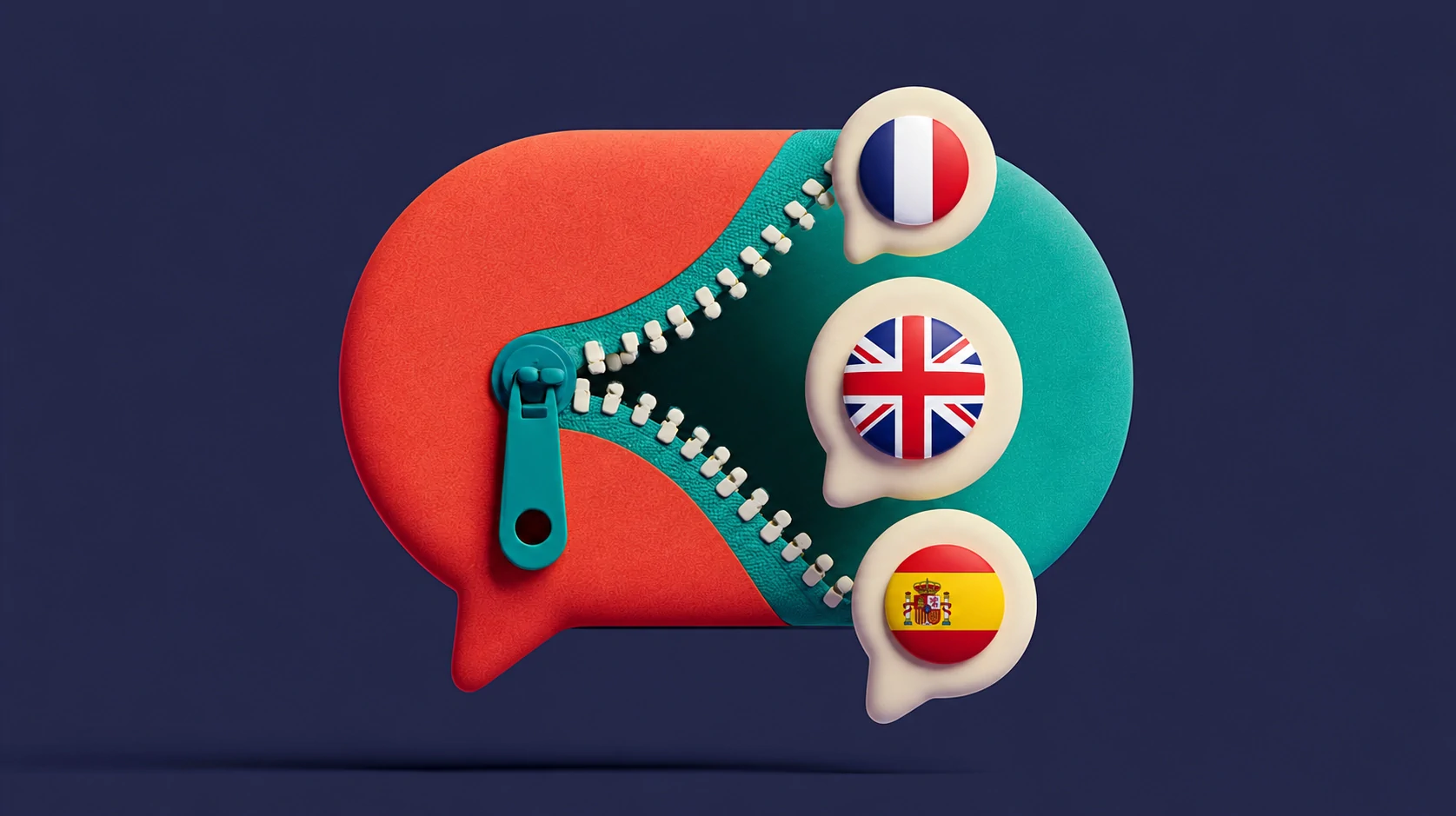
The part that surprises almost everyone is that you don't have to build an agent per language. You don't set up "the Spanish bot" and "the German bot" separately. The AI detects the language of each incoming message and replies in that same language, naturally, whether it comes in by chat or by phone.
And where does it get the answers? From your own knowledge. You upload your prices, services, hours, and policies once—your knowledge base—and the AI answers with that information in the language of whoever's asking. It doesn't translate canned phrases: it says what your business would say, in German, French, or Spanish, as the case may be. It works the same for chat and voice: an AI voice agent answers the phone and handles the call in the caller's language, with no "press 1 for English" menus, resolving or booking directly.
And one billing detail worth being clear about: Totem is a flat monthly plan with a bundle of included minutes and messages. AI usage draws down that bundle—a call it handles spends minutes, inbound or outbound—and if you go over in a given month, you top up with a one-time add-on and can set a spend cap. The upside is predictability: you know what you pay each month. If you want to hear how it sounds today, we cover it in AI voice agent for business.
Serving multiple languages without hiring: the human steps in when needed
The AI is excellent at the repetitive stuff and available when no one else is. But there are moments when a customer needs a person: a complaint, a negotiation, a delicate case, a situation that goes off-script. That's where the hybrid model makes the difference.
With TotemAI, anyone on your team picks up the conversation in one click. It's a warm handoff: whoever steps in gets the full thread, with everything the AI has already gathered, and in the customer's language. The customer doesn't repeat a thing. And here's the nuance almost nobody accounts for: your team doesn't need to be fluent in that language to follow the conversation, because they have in front of them the context the AI already understood and summarized. The human touch is preserved without language being a wall.
Myth
To serve several languages, you have to hire someone per language.
Reality
The AI detects and replies in each customer's language; one team covers every language, in voice and chat.
Myth
A multilingual AI loses the personal touch.
Reality
The AI covers the immediate stuff; your team steps in with one click, with the context summarized, exactly when it adds the most.
Myth
Serving European customers with AI is a legal headache.
Reality
The AI discloses that people are talking to an AI (transparency under AI Act art. 50.1) and can escalate to a person; if you handle EU residents' data, the GDPR applies.
And, of course, a customer can always ask to speak with a person: the AI offers that escalation path at any time. It's worth clearing up the usual myth: the GDPR doesn't grant a "general right to talk to a human" in customer service. The right to human intervention under GDPR art. 22 (and comparable regimes) arises only for decisions made solely by automated means that produce legal or similarly significant effects on the person; a bot that books, informs, or schedules normally doesn't fall under that. Even so, offering escalation to a person is a good trust practice, which is why it comes standard. On how that handoff works under the hood, we cover it in depth in you don't lose the human touch: handoff with context.
Multilingual service by industry: hotels, clinics, and real estate
The pattern repeats in any business whose customers cross borders, but it stands out especially in three verticals we work with every day.
| Industry | What multilingual AI customer service solves |
|---|---|
| Hotels | A guest asks at night and in their own language; the AI captures the direct booking with no OTA commission and routes every request. |
| Clinics | International patients comparison-shopping; the AI informs, qualifies, and books in their language, 24/7, without overwhelming the front desk. |
| Real estate | Out-of-town buyers message about a listing; the AI replies instantly in their language and books the showing before they go cold. |
At a hotel, answering first and in the guest's language is what turns a midnight inquiry into a direct booking instead of a commissioned one; we go deeper in multilingual AI agents for hotels. At a clinic or a real estate agency, the same logic applies: the lead who writes in another language is the one that goes cold fastest if nobody answers.

And nothing gets lost along the way. Behind the scenes, every conversation lands on a Kanban-style lead board where the AI moves the contact based on what happens, and it's logged with its full history. The French customer who asked about an event space and went quiet is still right there, waiting for follow-up, not buried in an endless chat thread.
Key takeaways
- The AI detects the language of each message or call and replies in that same language: it answers the phone in ~1 second and replies to messages right away, 24/7.
- You don't build an agent per language: multilingual replies come standard, powered by your own knowledge base.
- One team covers customers in multiple languages, with no hiring per language or per shift.
- The one-click human handoff keeps the context summarized, so language is never a wall for your team.
- Built to EU-grade standards: AI disclosure (transparency under AI Act art. 50.1), escalation to a person, and data handling under the GDPR—a strict baseline that holds up even if you serve EU customers.
Official sources
- AI Act (Regulation (EU) 2024/1689), art. 50 (transparency) and art. 113 (application timeline) — EUR-Lex
- GDPR (Regulation (EU) 2016/679), art. 22 (automated decisions) and Chapter V (international transfers) — EUR-Lex
Setting it up isn't a months-long project: TotemAI goes live in 48–72 hours, with no lock-in. The Pro plan (€179/mo plus applicable tax, the most popular) comfortably covers voice plus chat; with the annual plan, two months are free. And because it's a flat monthly plan with included minutes and messages, serving multiple languages carries a predictable cost: you know what you pay each month.
Frequently asked questions
How many languages can the AI handle?
The AI detects the language of each message or call and replies in that same language, in both chat and voice. That covers virtually all international customers without you having to hire staff per language or per shift.
Do I have to set up each language one by one?
No. You don't define an agent per language: detection and replying in the customer's language come standard. You provide your knowledge (prices, services, policies) once and the AI uses it to answer in the language of whoever's asking.
What if the customer prefers to talk to a person?
They can ask at any time. The AI answers first and, in one click, someone on your team picks up the conversation with the full history in front of them—a warm handoff—in the customer's language, without them having to repeat themselves.
Is it GDPR-compliant if I serve EU customers?
It's built to help you comply, but compliance depends on how you configure and use it. The AI discloses that people are talking to an AI—a transparency obligation under the EU AI Act (art. 50.1 of Regulation (EU) 2024/1689)—it can escalate to a person whenever a customer asks, and if you take calls from or handle data of EU residents, the GDPR applies. GDPR doesn't require data to stay physically in the EU: it permits international transfers with appropriate safeguards (Chapter V of the GDPR). If you operate in the US, regimes like the TCPA (calls and texts) and CCPA (data) may also apply. This is informational and not legal advice; consult your data protection officer or a lawyer.
Which languages does it handle best for customers in the US?
The most common languages of international customers reaching a US business—Spanish, French, and German, on top of English—are handled naturally by voice and chat. Because the AI detects the language of each message, there's no fixed list: it replies in whatever language you're written in.
Is it cheaper than hiring someone who speaks other languages?
Usually, yes. Instead of adding a person per language and per shift, one team covers every language with the AI up front. Plus, you pay a flat monthly plan with included minutes and messages, so you know what customer service costs each month.
Related reading

Franchise & Multi-Location CRM: Give Every Branch Its Own WhatsApp and Channels
One CRM for franchises and multi-location businesses: give every branch its own number, WhatsApp and channels while HQ sees the whole group in one view.

AI Receptionist Results for Small Business: +43% Bookings, −62% No-Shows, Double the Sign-Ups (With the Fine Print)
Real AI receptionist results for small business: +43% bookings, -62% no-shows and double the sign-ups, with the fine print on every figure.

AI Agent for Accounting Firms: Answers From Your Own Knowledge (RAG)
An AI agent for accounting firms answers repeat questions from your own knowledge base (RAG), qualifies each case, and books the consultation.
AI to Write Your Follow-Up Messages: Draft Helpers with RAG
AI drafts your lead follow-up messages from your knowledge base (RAG) and each lead's history. You review and send in seconds—no made-up facts.
 Book a demo
 by
by  Totem Studio