AI or a Call Center? You Don't Have to Choose: The Hybrid Model
TL;DR
Don't choose between AI and a call center: use them together in a hybrid model. The AI answers first, screens, and handles the volume 24/7 — picking up the phone in ~1 second and replying to messages right away — and takes several conversations at once; your agents, in-house or outsourced, take the sensitive stuff with full context. A one-click warm handoff joins the two layers so your customer never repeats a thing.
AI or a call center? If you're torn between standing up an AI agent or beefing up your call center, the honest answer is that you don't have to choose: what wins at a small business is combining them into a hybrid model. The AI answers first, screens, and handles the bulk of the volume 24/7; your agents — in-house or outsourced — take what genuinely needs a person, and they do it with full context in front of them. It's not one layer against the other: it's each doing what it does best. Let's look at how the work splits and why that split is the one that moves the needle.
"AI or a call center": why it's a false choice
The question "AI or a call center?" sounds like a budget decision, but it's really a false dilemma. A call center — whether that's your own team or an outsourced service — spends much of the day on the repetitive stuff: "what time do you open?", "I'd like to book an appointment", "how much is the first consultation?". That noise ties up your people right when the call that actually matters comes in, and leaves it ringing or dropping to voicemail.
The problem isn't a shortage of agents. It's that you're using an expensive, empathetic resource — a person — for tasks that need neither dollars nor empathy. And the reverse: when all you have is AI, you're missing the human judgment for the emotionally charged complaint or the delicate negotiation. Framing it as "one or the other" forces you to give something up. The hybrid model gives up nothing.
The question isn't "AI or people?" It's "how do I get each to do what it does best?"
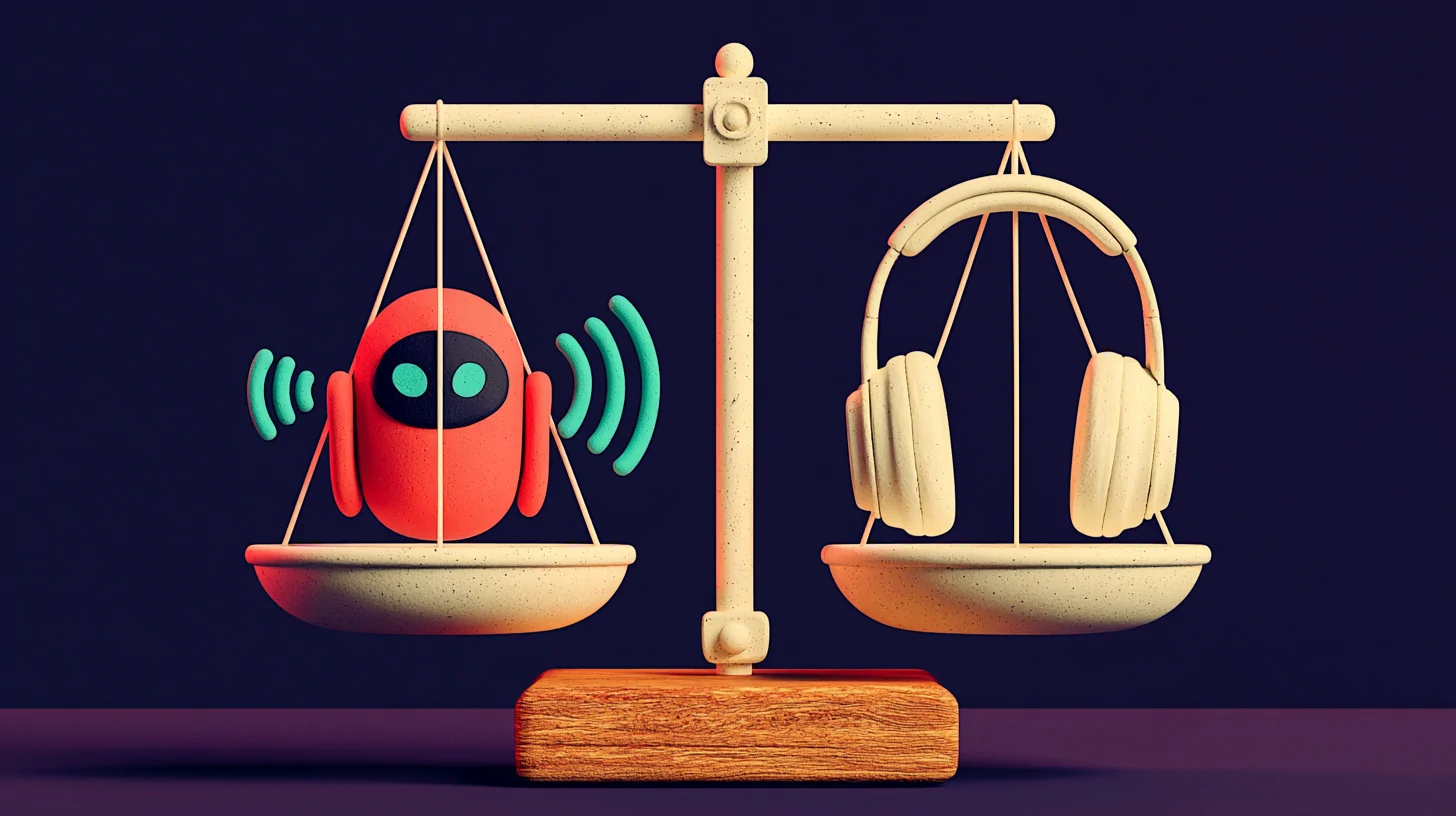
The hybrid AI + human model: how the work splits
The split isn't a design whim: it comes out of what each layer does better. The AI wins on volume, speed, and availability; the person wins on empathy and judgment. Read it with your guard down, because it's honest in both directions.
| Type of contact | The AI takes it | A person takes it |
|---|---|---|
| Hours, prices, first questions | – | |
| Book or move an appointment | – | |
| Three calls at once on a Monday at 10:30 | – | |
| Nights, weekends, and holidays | – | |
| An emotionally charged complaint | – | |
| Delicate negotiation or a complex sale | – | |
| A key customer who wants to feel heard | – |
The AI absorbs the noise — which is most of the contacts — and leaves your agents only what genuinely needs a human. It's not that people work less: it's that they work on what closes, calms, and builds loyalty, instead of playing switchboard. According to our clients, that filter frees up so much time that the team responds far faster to what matters.
24/7
coverage without adding headcount, nights and holidays too
60%
less response time, according to our clients
+55%
more leads treated as a priority, at a typical small business
And it's worth remembering why speed matters so much: a study by MIT's Oldroyd, popularized by Harvard Business Review, found that contacting a lead within the first 5 minutes makes you 21 times more likely to qualify it than reaching out at 30. A person can't guarantee that speed when several calls come in at once or it's nine at night. The AI answers in ~1 second, every time.
Warm handoff from AI to agent: your customer never repeats themselves
The thing that keeps the hybrid from being a patch job is the handoff. In a classic call center, when a call jumps from one person to another, the customer repeats their case from scratch — and you feel the bump. Not here.
Good morning, this is Northside Clinic. How can I help you?
Hi, I need to move my appointment to Friday.
No problem. Friday at 11:00 is free, shall I confirm it?
The AI answers first
24/7, no queues or voicemail: it picks up the phone in ~1 second and replies right away on WhatsApp, Instagram, Messenger, SMS, or web chat. Nobody waits or drops to voicemail.
It qualifies and handles the volume
Hours, prices, first questions, booking into your calendar. Most contacts are resolved right here, without bothering anyone.
It spots what needs a person
A complaint, a delicate case, a complex sale. The AI identifies it and preps the handoff.
Warm handoff, one click
An agent takes over the conversation with the full history in front of them. The customer doesn't repeat a thing; the person comes in already up to speed.
That continuity is the difference between a real hybrid and two systems taped together. The conversation is a single one; what changes is who's carrying it at any given moment. We break it down in detail in how the handoff from AI to a human agent works, with context.
The cost of an AI call center: 24/7 coverage without blowing up payroll
Here's the part that convinces whoever pays the bills. A call center that genuinely covers nights, weekends, and holidays needs shifts, and shifts need payroll. The hybrid model changes the cost structure: the AI absorbs the volume without adding headcount, and you save your people for the time slots and cases where they make the difference. You're not hiring more operators; you're adding a layer of AI customer service that works in parallel with the one you already have.
And there's one detail about Totem worth underscoring: you pay a flat monthly plan with a pool of minutes and messages included. Usage draws down that pool, so you know what you pay each month; and if a spike leaves you short, you extend with a one-time top-up or set a spending cap. What you get isn't a meter that spikes with every call, but a predictable cost you can budget for.
0 calls to voicemail
The cost that weighs the most, in fact, doesn't show up on any payroll: it's the opportunities that go cold. Most people who call and get no answer don't leave a voicemail; they hang up and call the next name on the list. The hybrid plugs that leak by design, because there's always someone — the AI — on the other end within the first second.

How to set up the hybrid AI + call center model, step by step
Setting it up is less work than it looks, especially because you don't have to scrap anything that already works.
- Put the AI on the front line. On the phone and on every text channel. You can keep your current number and phone system and send it your forwarded or overflow calls.
- Define what it handles on its own. Hours, prices, booking and moving appointments on booking pages synced with Google or Microsoft Calendar, reminders by WhatsApp or voice.
- Set the handoff threshold. Which signals — a complaint, a keyword, an explicit request — bump the conversation to a person.
- Connect your agents. In-house or outsourced: they take over in one click, with the context in front of them, from the web or the native iOS and Android apps.
- Measure and adjust. The dashboard gives you response rate and sentiment per conversation, and the lead board moves itself based on how each call went, no Zapier.
One piece people underestimate: the same platform that routes calls also unifies WhatsApp, Instagram, Messenger, SMS, email, and web chat in a single inbox, and follows up with leads on human cadences — a "no" stops the sequence. You're not choosing between AI and people: you're building a layer that works alongside your team.
What matters
- "AI or a call center?" is a false choice: combining them wins, not choosing.
- The AI filters and handles the repetitive volume 24/7; people take the sensitive cases.
- The one-click warm handoff passes the full context: the customer never repeats a thing.
- A flat monthly plan with minutes and messages included: you know what you pay each month, with no surprises and no meter running out of control.
- Serving EU residents? AI disclosure is required (AI Act art. 50.1); we offer handoff to a person as best practice, not as an art. 22 GDPR right; data hosted in the EU as a product decision.
If you want to compare specific layers, there's AI voice agent vs. a human answering service, the breakdown of AI receptionist vs. human receptionist, and the complete guide to the AI voice agent for business.
Official sources
Frequently asked questions
Does the AI replace my call center or my agents?
That's not the goal. The AI answers first, qualifies, and handles the repetitive volume, then passes the sensitive cases — with full context — to a person. Your agents, in-house or outsourced, stop firefighting on the phone and focus on the conversations that actually close or calm things down. It's a division of labor, not a replacement.
How is the work split between the AI and people?
By nature. The AI does what it's good at — 24/7 availability, several calls at once, hours, prices, booking appointments — and people do what they're good at — empathy, judgment, negotiation, sensitive cases. The AI filters out the noise so your team only sees what actually needs a person.
Does the customer have to repeat their case when it moves to a person?
No. In TotemAI the handoff is warm and one-click: the agent picks up the conversation with the full history in front of them, so they come in already up to speed. The customer doesn't repeat a thing. On top of that, the system discloses that people are talking to an AI — the transparency duty in the EU AI Act (Regulation (EU) 2024/1689, art. 50.1), which Totem meets by default — and, as best practice, always offers the option to switch to a person.
Is the hybrid model cheaper than a classic call center?
For most small businesses, yes, because you change the cost structure: the AI absorbs the volume without adding to payroll and covers nights, weekends, and holidays. On top of that, with TotemAI you pay a flat monthly plan with minutes and messages included, so your cost is predictable month to month.
Can I keep my current number and phone system with a hybrid model?
Yes. You don't have to scrap anything that already works. You keep your number and your phone system and send the AI your forwarded or overflow calls, so it answers first when your team can't get to them. AI and people coexist on top of your current telephony; it's not a change of provider, it's a layer on top.
Does the hybrid model only work for calls, or for WhatsApp and other channels too?
Both. The same platform routes calls and unifies WhatsApp, Instagram, Messenger, SMS, email, and web chat in a single inbox. The AI answers first on any channel and, when a person is needed, the warm handoff passes the context just like on a call.
Related reading

WhatsApp vs SMS for Business: Which to Use in Your Small Business and When Each Channel Wins
WhatsApp vs SMS for business: open rates, cost per message, and when to use each channel in your SMB—plus how to run both from one inbox.

Monthly or Annual Plan in TotemAI: 2 Months Free, No Lock-In
Monthly vs annual plan: annual gives you 2 months free (pay 10, use 12) and neither locks you in. Pick the billing cycle that fits your cash flow.

All-in-One Platform vs Separate Tools: Voice AI, WhatsApp, Booking, and CRM
All-in-one platform vs separate tools: four apps glued with Zapier lose 1 in 7 leads. Compare real cost, seams, and upkeep for your SMB.

AI Receptionist vs Human Receptionist: The Real Cost for a Small Business
AI receptionist vs human receptionist: the real monthly cost in dollars, hours covered, simultaneous calls and why the hybrid model wins.
 Book a demo
 by
by  Totem Studio