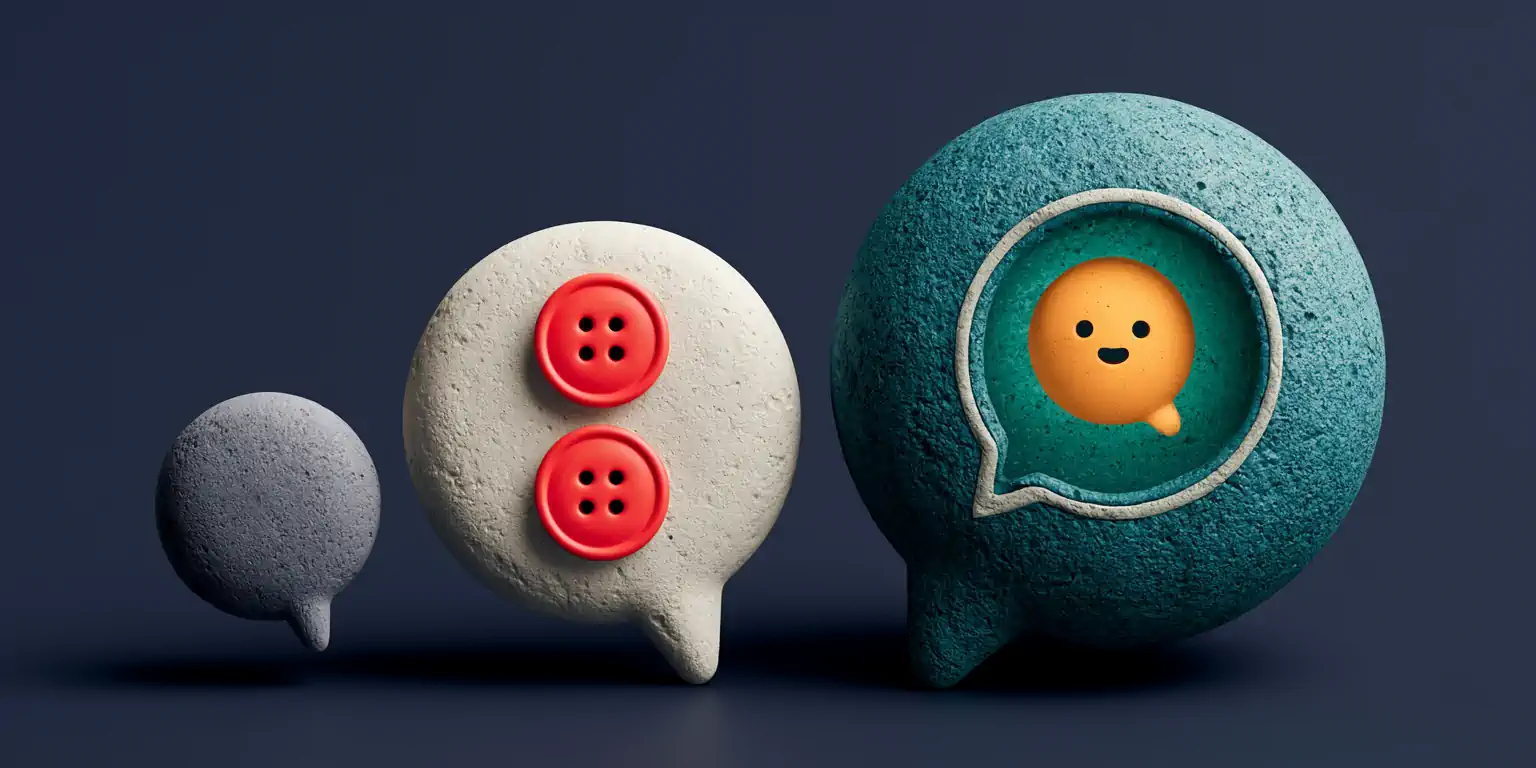
Chatbot vs. AI Agent on WhatsApp: Which Does Your Small Business Need?
TL;DR
The difference between a chatbot and an AI agent on WhatsApp: a chatbot walks you through a closed button menu; an AI agent understands free-form language, answers with your information, books the appointment, and hands off to a person. An auto-reply only acknowledges. If your customers ask real questions and want to book, you need an agent, not a menu.
If your customer texts "do you have an opening Thursday afternoon?" at 10:30 p.m. and gets back "Thanks for your message, we'll reply during business hours," you don't have an assistant: you have an answering machine. The real question when you want to automate your WhatsApp is choosing well between a chatbot vs. an AI agent (and understanding why neither is the same as a plain auto-reply). They're three levels sold the same way but doing very different things: an auto-reply, a button chatbot, and an AI agent all sound alike on the vendor's website, but in your WhatsApp they behave like three different animals. Here's what each level does, where it breaks, and which one your small business actually needs.
Auto-reply, chatbot, and AI agent: three levels everyone calls the same thing
The confusion is a vocabulary problem. "Automating WhatsApp" can mean three things a decade of technology apart. And because all three are marketed with the magic word "AI," it's easy to pay for the third and walk away with the first.
The quick way to tell them apart: watch what happens when the customer writes something nobody anticipated. The auto-reply ignores the question. The button chatbot offers an option that doesn't fit. The AI agent understands it and resolves it. That's the whole difference between a chatbot and an AI agent, and it's what decides whether you capture the appointment or lose it.
Key takeaways
- Auto-reply: fires a fixed message. Understands nothing. Useful for acknowledging, useless for resolving.
- Button chatbot: a navigable menu. Works if your question is on the menu; gets stuck if it isn't.
- AI agent: understands free-form language, answers with your information, books, and hands off to a person. The only one that holds a real conversation.
- The right question isn't "do I want AI?" but "do my customers ask real questions and want to book?" If the answer is yes, you need level 3.
Level 1: auto-replies (useful, but dumb)
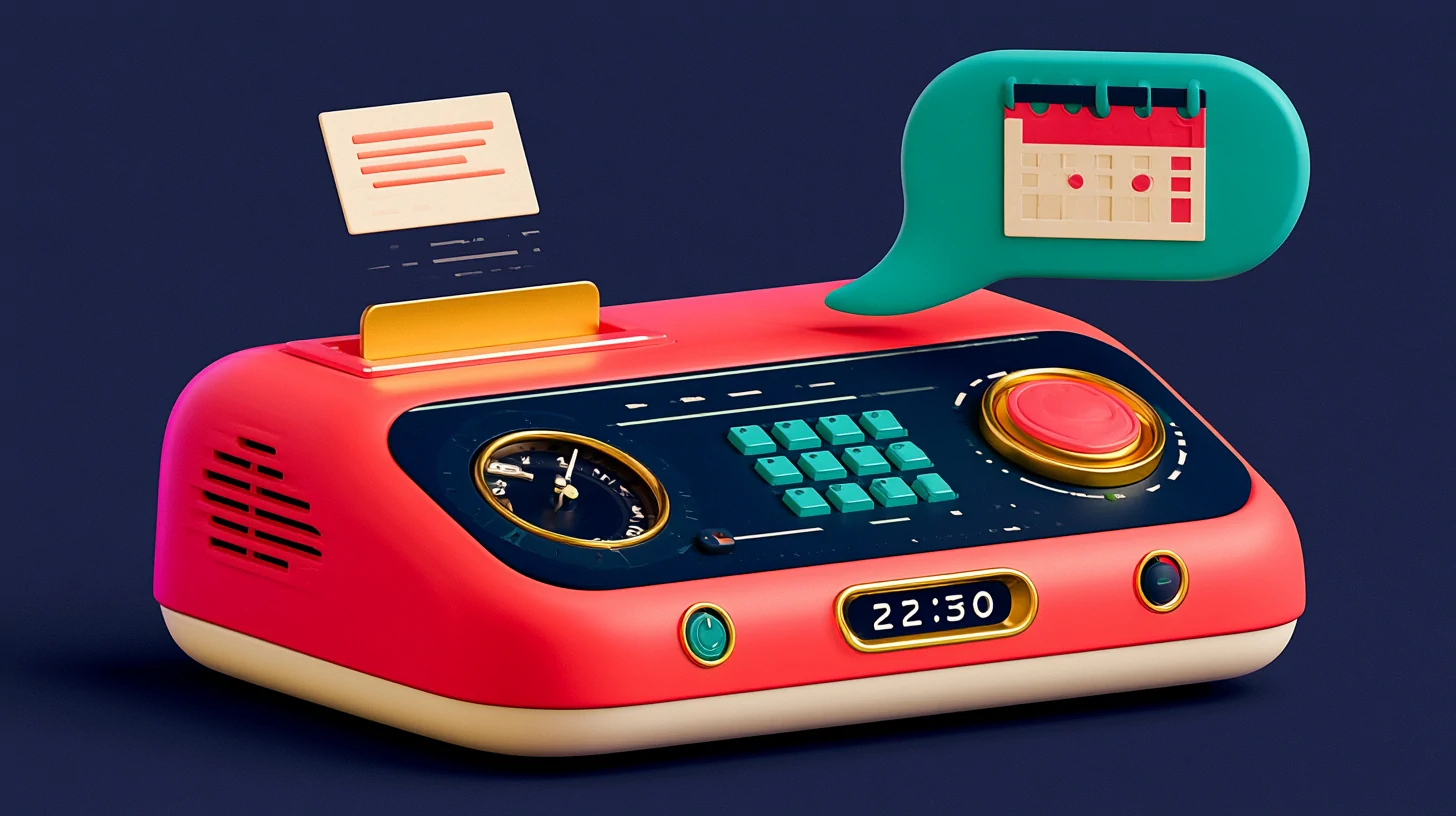
It's what WhatsApp Business ships with out of the box: the welcome message and the away message. You write the text once and it sends itself when someone messages you after hours or for the first time. That's it.
It's not bad. In fact it's the decent minimum: nobody's left without an acknowledgment. The problem is what it promises without delivering. An away message says "we'll get back to you soon," but it doesn't answer, doesn't book, and doesn't capture the customer's details. If that person had buying intent at 10:30 p.m., that intent cools off until tomorrow — and by tomorrow they're already looking at your competitor.
If you're here and want to take the first step well, this guide to automating WhatsApp Business for small businesses explains how to set up the basics without getting tangled up. It also helps to decide first whether you need the WhatsApp Business app or the API, because the level of automation you can reach depends on it.
Level 2: the WhatsApp button chatbot (a menu, not a conversation)
The classic chatbot is a tree. "Press 1 to book, 2 for hours, 3 to talk to an agent." Each button leads to another set of buttons. It's predictable, it's cheap, and done well, it resolves the three or four most common questions without human intervention.
Its ceiling is exactly that: it only knows what fits on the menu. The customer who writes "I got Botox two weeks ago and there's a hard spot, is that normal?" won't find that button. The bot offers "1. Book 2. Pricing 3. Hours," the person gets frustrated and leaves. A menu isn't a conversation; it's a form in disguise.
Myth
A WhatsApp chatbot already understands my customers.
Reality
A button chatbot understands nothing: it navigates a menu. Only one that uses generative AI interprets what the customer writes in their own words.
Myth
If it has buttons, it's safer and more controllable.
Reality
It's more rigid, not safer. When the question goes off-script, the button leaves you hanging and the customer walks. An AI agent tightly scoped to your information is controllable AND flexible.
Myth
Programming a button chatbot is an investment that lasts for years.
Reality
Every new question is a new button someone has to create and maintain. The tree grows, turns into a maze, and nobody updates it.
Where the button chatbot does shine is in closed, repetitive flows: confirming an appointment, choosing between two services, leaving a phone number. If your use case is booking and little else, see how a WhatsApp chatbot for booking appointments and reducing no-shows fits. For everything else, the menu is a wall.
Level 3: the AI agent on WhatsApp that understands, books, and hands off to a human
This is where the game changes. An AI agent doesn't navigate a tree: it reads what the customer writes, understands it, and answers with your information — the real thing (your prices, your services, your availability), not generic phrases. It takes questions in free-form language, in the customer's language, and keeps the thread of the conversation.
And it does three things neither the fixed message nor the menu can do. It answers right away, no queues or voicemail, at any hour. It books the appointment directly against your Google or Microsoft calendar. And when the conversation needs a person, it hands it to your team in one click with full context, without the customer repeating anything: the warm handoff. The AI answers first; you take over when you genuinely add value.
~1 s
to pick up the phone, 24/7
+50%
more appointments booked, according to our clients
−35%
fewer no-shows with reminders, according to our clients

It's not just WhatsApp. The same agent handles Instagram, Messenger, SMS, web chat, and calls, and whatever comes in through any of them lands on a single Kanban-style lead board. The AI moves the lead through stages based on what happens (no Zapier, no glue), and the follow-up cadences are "human": a "no" from the customer stops the sequence instead of firing it five more times. If you want to see why an agent like this is a different category from the old-school contact record, we dig into it in AI agent vs. traditional CRM.
Comparison table: auto-reply vs chatbot vs AI agent
If you had to keep one image, make it this comparison table. All three options coexist in the market, but only one holds a conversation from start to finish.
| What it handles | Auto-reply | Button chatbot | AI agent |
|---|---|---|---|
| Acknowledge after hours | Yes | Yes | Yes |
| Understand free-form language | No | No | Yes |
| Answer with your real info | No | Limited | Yes |
| Book on your calendar | No | Sometimes | Yes |
| Hand off to a person with context | No | Just transfers | Yes, warm |
| Cover multiple channels and calls | No | No | Yes |
When does each one fall short? The auto-reply, the moment the question is worth money. The button chatbot, the moment the customer goes off-script. The AI agent has its own limit, and it's healthy to admit it: anything that needs human judgment, empathy, or a delicate decision it passes to your team, which is what they're there for. The difference is that it decides well when to do so.
The question isn't "should I automate WhatsApp?" It's "what happens when my customer writes something nobody programmed?" That's where you see who has an agent and who has an answering machine with pretensions.
For most small businesses with customers who ask questions, compare, and want to book (med spas and dental clinics, real estate agencies, hotels, driving schools, restaurants, hair salons, home services), the honest answer is level 3. Not because it sounds modern, but because it's the only one that turns a 10:30 p.m. question into a booked appointment before the customer falls asleep.
And one reassuring detail when you run the numbers: with Totem you pay a flat monthly plan with minutes and messages included, no contract, so the cost is predictable month to month. If you come up short one month, you top up with a one-time add-on and you can set a spending cap. Going from an answering machine to an agent that genuinely handles customers doesn't have to blow up your bill.
Official sources
Frequently asked questions
Is a WhatsApp auto-reply already a chatbot?
No. An auto-reply (the classic away greeting) just fires a fixed message and doesn't understand anything the customer writes. A chatbot offers buttons and paths; an AI agent understands free-form language, answers, and books. They're three different levels.
How can you tell it's an AI agent and not a button chatbot?
A chatbot forces you to pick from options someone programmed; if your question isn't on the menu, it gets stuck. An AI agent understands what you write in your own words, answers with your information, and can book an appointment or hand you off to a person without making you repeat anything.
Does the AI agent replace my team?
No. It answers first and handles the repetitive stuff 24/7, but any conversation goes to a person on your team in one click, with full context. The idea is that your people spend their time on what truly needs a human.
Is it legal to use an AI agent on WhatsApp?
Yes. The core thing is to tell customers they're talking to an AI: that's the transparency duty the EU AI Act places on these systems (Regulation (EU) 2024/1689, art. 50.1) if you take calls from or handle data of EU residents, and it's a disclosure US regulators like the FTC expect as good practice either way. On top of that, if the agent handles personal data, it should do so under the applicable privacy law — CCPA/CPRA in California, and GDPR (Regulation (EU) 2016/679) if you serve EU residents. Offering to pass the conversation to a person is strongly recommended as good practice, though for an agent that only answers questions or books, GDPR art. 22 usually isn't triggered (it's reserved for solely automated decisions with legal or significant effects). In Totem, the AI disclosure, the human handoff, and privacy-compliant data handling all come built in.
Which is better for my business, a chatbot or an AI agent?
It depends on your inquiries. If your customers only choose between two or three fixed options (book, check hours, leave a number), a button chatbot is enough. If they ask different questions in their own words, compare, and want to book, an AI agent converts better because it understands, answers with your real information, and books without anyone having to step in.
Do I need the WhatsApp API to have an AI agent?
Yes. The welcome and away auto-replies work in the WhatsApp Business app, but an AI agent that understands free-form language and books against your calendar needs the WhatsApp Business API. That's what lets you connect the AI, cover multiple channels, and route to a person with full context.
Related reading
WhatsApp vs SMS for Business: Which to Use in Your Small Business and When Each Channel Wins
WhatsApp vs SMS for business: open rates, cost per message, and when to use each channel in your SMB—plus how to run both from one inbox.

Monthly or Annual Plan in TotemAI: 2 Months Free, No Lock-In
Monthly vs annual plan: annual gives you 2 months free (pay 10, use 12) and neither locks you in. Pick the billing cycle that fits your cash flow.

All-in-One Platform vs Separate Tools: Voice AI, WhatsApp, Booking, and CRM
All-in-one platform vs separate tools: four apps glued with Zapier lose 1 in 7 leads. Compare real cost, seams, and upkeep for your SMB.
AI or a Call Center? You Don't Have to Choose: The Hybrid Model
AI or a call center? You don't have to choose. AI handles the volume 24/7 and a person takes the sensitive calls with context. Here's the hybrid model.
 Book a demo
 by
by  Totem Studio